Start with the lifting duty
Choosing a crane starts with what has to be lifted, how often, over what area and in what environment — not with a catalogue. We review your requirement with the supplier and, where engineering input is needed, with PE Consultants Pte Ltd, then propose equipment options under the supplier's terms.
- Review of loads, span, lifting height, duty and site constraints
- Identification of suitable crane types and configurations
- Quotation and supply terms from the supplier, subject to technical review
- Coordination with supporting structure design, installation and maintenance where also required
- Documentation needed for delivery, installation and statutory inspection, as applicable to the country
Equipment categories
Overhead (bridge) cranes
For factories, workshops, warehouses and maintenance bays with repetitive lifting along a fixed runway.
Typical configurations: single-girder or double-girder bridge on runway beams.
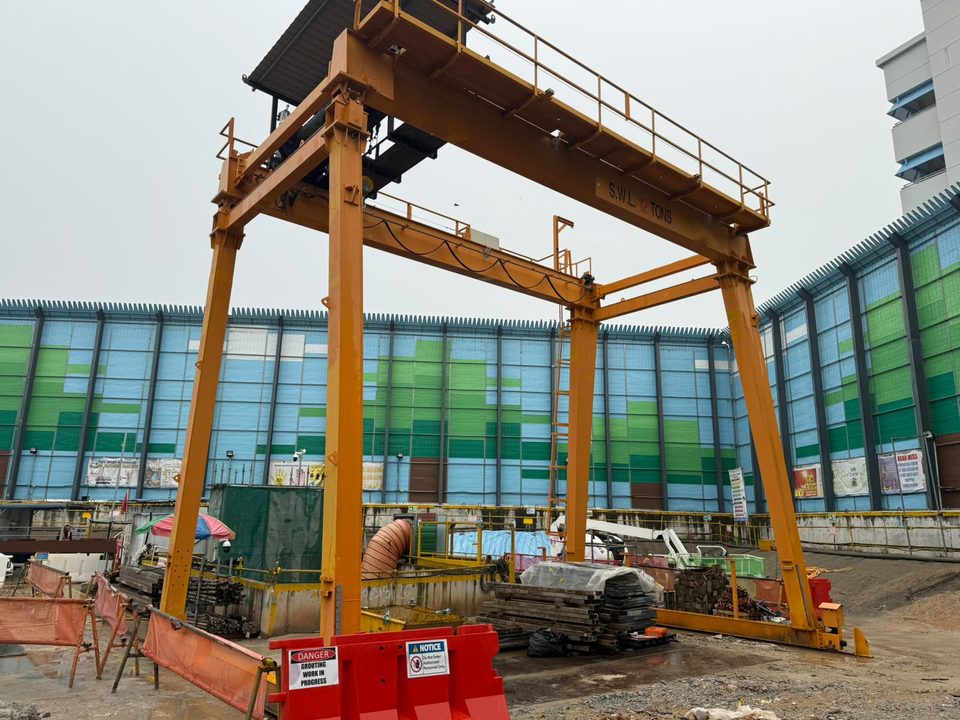
Gantry and semi-gantry cranes
For outdoor yards, precast and steel fabrication yards, storage areas and loading zones where no building runway is available.
Typical configurations: rail-mounted full gantry or semi-gantry.
Tower cranes
For building and infrastructure projects requiring sustained lifting over a fixed footprint.
Foundation and tie-in design are project-specific; see engineering support.
Other lifting equipment
Hoists, special-purpose lifting equipment and lifting solutions for specific applications, considered case by case.
Suitability is reviewed per enquiry.
The configurations above describe each crane type in general terms. The types, configurations and capacities that can be offered for your project are confirmed in the quotation, after a review of your requirement.
Parameters confirmed for each quotation
Technical details are stated per project in the quotation and supplier documents rather than as general figures on this website. A quotation will normally address:
| Parameter | What it covers |
|---|---|
| Capacity | Rated or safe working load (SWL) of the main and any auxiliary hoist |
| Span | Distance between runway or rail centrelines |
| Lifting height | Height of lift from floor or ground to the highest hook position |
| Duty classification | Classification group to the standard specified for the project, based on load spectrum and usage |
| Operating environment | Indoor or outdoor, temperature, humidity, dust, corrosive or hazardous-area conditions |
| Configuration | Girder type, hoist type, travel speeds, control method and power supply |
| Standards | Design and manufacturing standards specified by the client or required for the project |
Frequently asked questions
What types of cranes and lifting equipment can I enquire about?
You can enquire about overhead (bridge) cranes, gantry and semi-gantry cranes, tower cranes and other lifting equipment. Whether a particular type, configuration or capacity can be offered is confirmed for each enquiry after a review of the requirement. See Cranes & lifting equipment.
Does QP Advisory or PE Consultants manufacture cranes?
No. Cranes and lifting equipment are designed and manufactured by the supplier. QP Advisory is the marketing agent and PE Consultants is an engineering consultancy; neither manufactures equipment.
What information should I provide when requesting a quotation?
Helpful information includes the project location, the lifting application, the required safe working load, span and lifting height, the operating environment, whether you need new equipment, rental, maintenance or financing, the expected timeline, and any drawings or specifications. See Request a quotation.